NOV 20, 2026 · The News
Money down the phone

Scammers have a way of targeting us when we least expect it. Imagine that on a certain afternoon, while going about your normal routine, you get a call from an unknown person claiming to be from your bank. They have done their research, so they know which bank you use, and you have no reason to doubt them.
Next, they notify you that your account has an issue and will be blocked unless you read out the code sent to your phone. As you obediently read out the code, within minutes all your savings are gone. You only realise later that the calm, professional voice that walked you through every step belonged to a scammer.
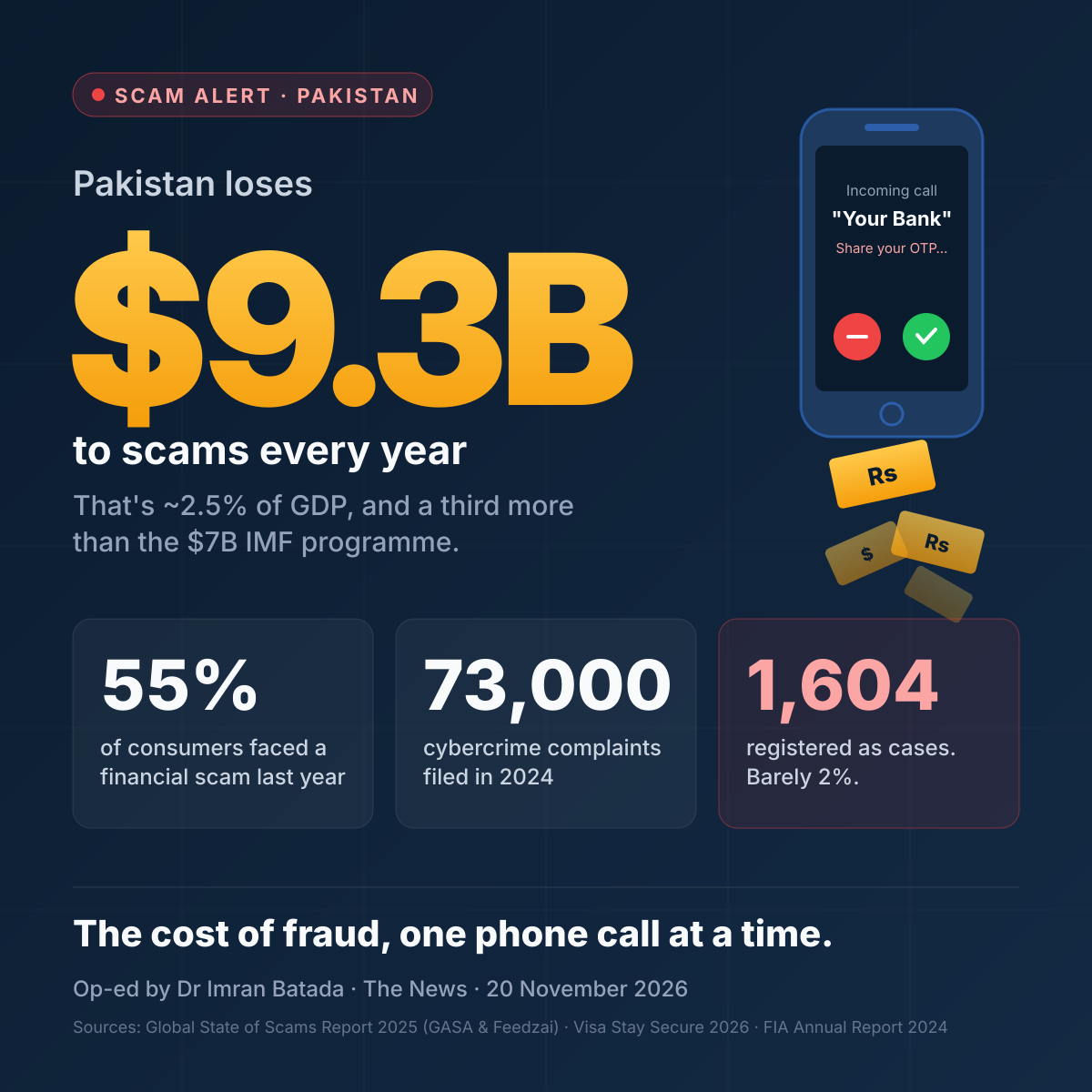
Many Pakistanis have their own versions of stories about how they got scammed. According to the Global State of Scams Report 2025 by the Global Anti-Scam Alliance and Feedzai, Pakistan loses about 2.5 per cent of its GDP to scams each year. This is roughly $9.3 billion, which is about a third more than the entire $7 billion IMF programme. That’s a huge loss to both citizens and the country, since money that could have been used wisely goes into scammers’ pockets.
We debate every IMF tranche for months, yet scammers take more each year than what the programme is worth. Also, according to Visa’s latest Stay Secure study, released in June this year, 55 per cent of Pakistani consumers surveyed said they had experienced a financial scam in the previous year. You can only imagine that more than half of those surveyed had been targeted in a single year. More people say they experience scams mostly through social media.
Official reports say that over the last three years, around 227,000 people have formally reported being defrauded, with reported losses of Rs8.32 billion, which is roughly $30 million. If you compare this with the estimated $9 billion a year, most of the damage never reaches a complaint desk.
Even reported cases rarely go far. For instance, in 2024, more than 73,000 cybercrime complaints were filed, but only 1,604 were registered as cases. The Banking Mohtasib resolved about 28,000 digital fraud complaints that year, recovering about Rs1.65 billion. A lot was still lost. Most of the scam victims tend to absorb the loss. Some become embarrassed that they got scammed, many lose amounts too small to be worth the effort, and few believe the money can come back.
The fake bank call is only one version. There are also fake investment schemes that spread through WhatsApp and social media. The main catch is often paying victims small profits at first to build trust before taking everything. Other scammers pose as bank staff, courier companies or government officers, warning that an account will be suspended.
Not only that, but you may also get a message from an apparent ‘relative’ in trouble who asks for money urgently. This is often over messaging, and you might send without thinking and later realise your relative’s phone had been hacked. Most scams end with the same request: share your OTP, PIN, or password.
Now, where it gets harder is the fact that the victims are the ones who actually authorise the transfer themselves. Because most scammers claim to be from the bank, victims trust them. In the end, the bank points to the customer, while the customer blames the bank, and this is where fraudsters operate. It is not just a consumer protection issue. It also goes to the heart of the digital economy we are trying to build in Pakistan.
There is a need for financial inclusion for first-time users: women opening their first mobile wallet, shopkeepers accepting QR payments, and older citizens receiving pensions digitally. These are actually some of the easiest targets. The impact of such scams is that many people go back to cash and warn others to avoid digital payments, undoing the progress financial inclusion efforts have made.
Freelancers also face their own versions of scams. Freelancers earned a record $1.76 billion in FY26; however, they face scams such as fake clients, phishing links disguised as payment alerts, and hijacked accounts. What makes the situation bad is the fact that easy, successful scams chip away at the trust that digital payments, e-commerce, and remote work all depend on. We can’t ask people to go digital while digital feels dangerous.
With all this going on, regulators have tried to help reduce these scams. For instance, since 2023, the State Bank of Pakistan has required banks to set up digital fraud risk management units to help with this. Also, in cases where users incur losses due to banks’ delays or failing to block a channel in time, the bank must compensate the customers. In February 2026, the SBP launched the Cyber Shield, a cyber resilience strategy for banks that runs until 2030.
The defence system looks stronger on paper than it feels to citizens. A few measures could close the gap. First, publish a quarterly national fraud dashboard to track how quickly suspicious transactions are flagged, how quickly accounts are frozen, how much money is recovered, and how many cases end in conviction. What gets measured gets fixed.
Second, there should be a joint anti-fraud cell. The SBP, PTA, NCCIA, banks, wallet providers and telecom operators should share data in real time. When a scam number is reported, it should be blocked within hours, not weeks; plus the WhatsApp account should be blocked, and the account receiving the money should also be blocked. Closer checks need to be made on accounts that suddenly receive many transfers and move the money straight out. This can help to break the chain at the weakest links.
Third, there should be a short cooling-off period for first-time large transfers to a new recipient, plus one nationwide helpline to stop a payment. This can help reduce the number of people becoming victims of scams. Finally, digital safety needs to be a basic skill and taught in schools and universities.
Pakistan spends months arguing over $7 billion from the IMF while more than $9 billion leaks away every year, one phone call at a time.
The writer is the author of ‘Digital Pakistan’ and holds the position of chief digital officer and director at the Centre for Information and Communication Technology at IoBM. He tweets/posts @imranbatada


